
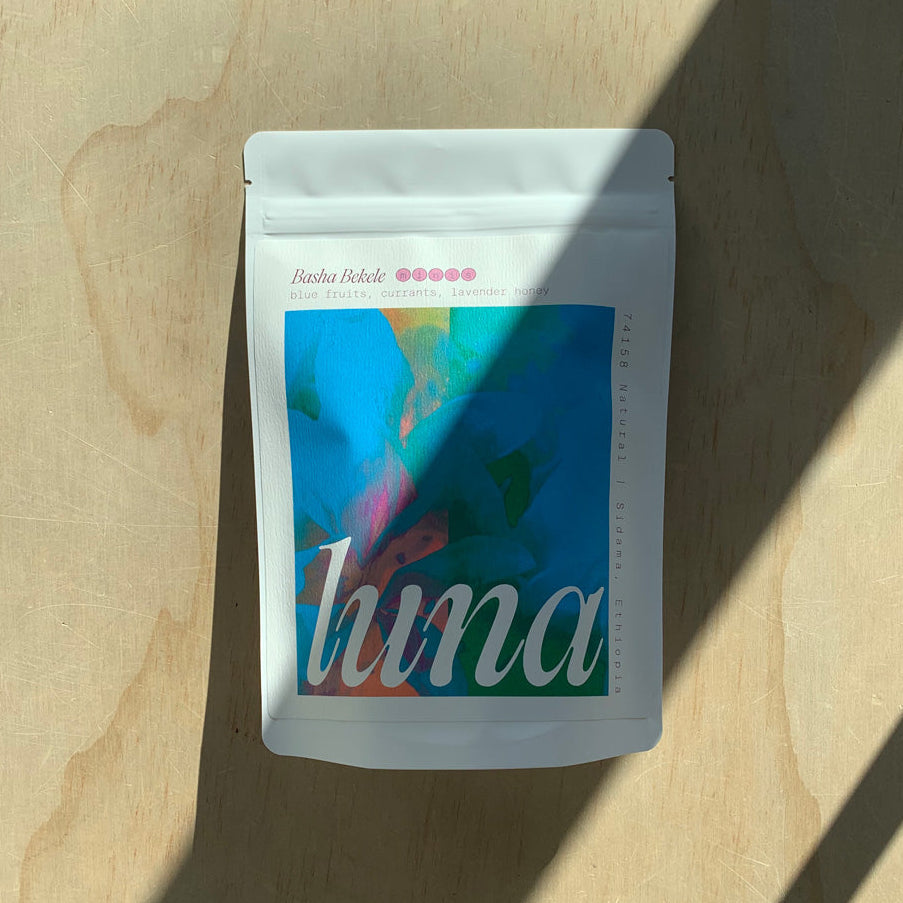
Ethiopia • Natural
Basha Bekele - minisJARC 74158
blue fruits • currants • lavender honey
Variety 74158 grown by 1st place COE winner (2024), Basha Bekele, on his farm in Bombe, Bensa, Sidama. Proccessed as a natural with whole fruit dried on raised beds. This lot is particularily special as it features the smallest screen sizes, not normally exportable. Moata, who works with Crop to Cup took it upon himself to painstakingly re-sort these 'minis', with the idea that these smaller fruits have outsized flavour. We're inclined to agree.
- Variety:
- 74158
- Location:
- Sidama, Ethiopia
- Harvest:
- Dec-Jan 2025/26
- Processing:
- Processed as a traditional natural, whole fruit dried on raised beds allowing yeasts time to transform them. Sorted by screen size at the point of milling, these minis are typically left behind and not processed for export. Moata saw an opportunity to save them.
- Cup Profile:
- Blue fruits, dried sweet currants and lavender honey
Basha Bekele - minis
It's incredibly rare to be both the producer/processor and farmer of a coffee in Ethiopia.
The story of Basha Bekele's coffee is also the story of Bombe, the community in Bensa where his family has farmed for generations. His father managed a cooperative there that supplied the Sidama Union; before export licenses were made available to smallholders, both father and son sold through that system. Basha now works under his own license, farming 12 hectares of semi-forested plots planted with 74158, the varietal known locally as Walega, and operating collection sites across Bombe, Shantawane, Kokose, and Badigalo, the last of which was added in the 2025/2026 season at even higher elevation than his other sites. Through those sites he buys cherry from over 150 neighbouring producers farming as high as 2,300 metres.
For more on Basha and this topic, check out this journal we wrote in the archive.
JARC 74158
A specific type that is known to thrive in Bensa and surrounding are as of Sidama & bred by Jimma Agricultural Research Centre, officially releasing it as 74158 Landrace in 1974.
Processing
Nearly everything Basha produces is dry-process. This starts by floating the fruit, then meticulous drying on raised beds with continuous sorting through the subsequent days and weeks, the first days starting under shade. Naturals or sun-dried tend to be yeast dominant at the microbial level, and promote more heady fruit and creamy flavour.
Brewing ideas
There are plenty of other great recipes out there. If you have one you already use, that's a great place to start. If you're looking for some guidance, this is our main QC V60 recipe.
V60-02 (ceramic) • 1:17 ratio (15g.:255g.) • 93C
- 0:00 - 55g. Bloom, gentle swirl just to make sure everything is saturated
- 1:00 - 155g. Center pour with dime sized circular motion until about 120g. then spiral pour out to include outer rim until 155g. finish pour around 1:20
- 1:40 - 255g. Center pour with dime sized circular motion until about 220g. then spiral pour out to include outer rim until 255g. finish pour around 2:00; gentle swirl to aid in even drawdown
finish around 3:00 depending on grinder and filters
We're using Abaca filters and grinding around 600um @900rpm on our Z2 80mm ULF burrs
Water:
Low ppm (Vancouver municipal water is about 23ppm, Maple Ridge is about 32ppm); or Lotus water Ultra Light (about 45ppm)/ TWW 1/2 strength give great results too.
Resting:
Best rested for 2 weeks after roast date