
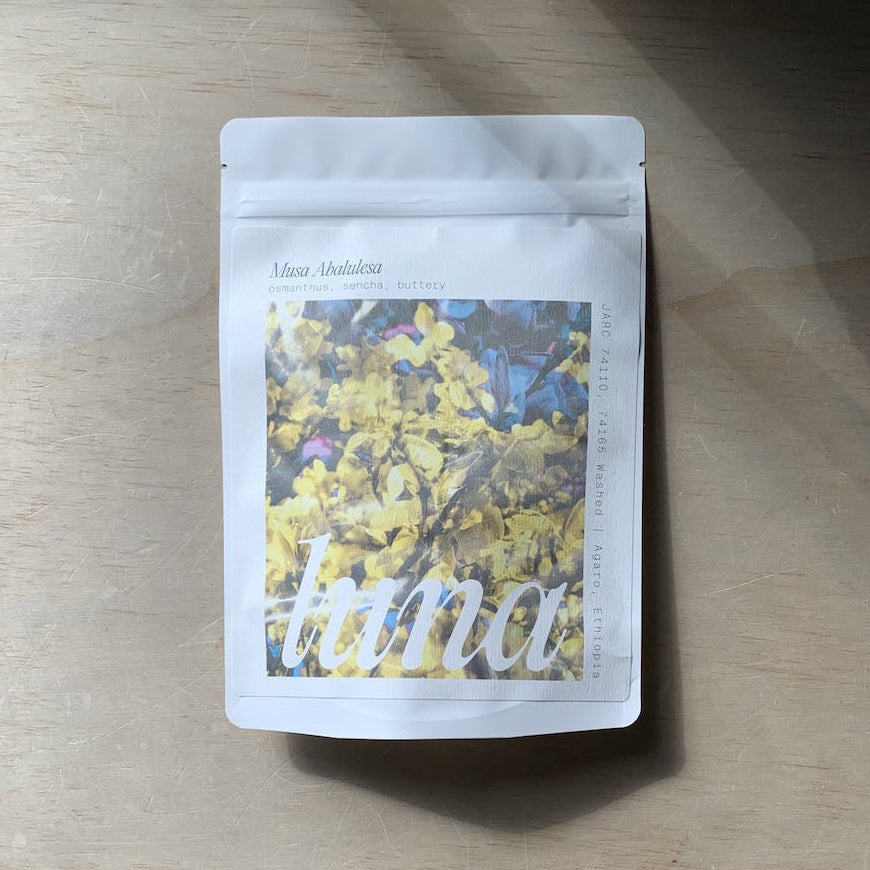

2026 (July) Ethiopia • Washed
Musa AbalulesaJARC 74110, 74165
sencha • osmanthus • honey-melon
JARC 74110 & 74165 varieties grown by Musa Abalulesa, his brother, & a few neighbours, in Agaro, Ethiopia. Processed as a traditional (for Agaro) washed & dried on raised beds, the resulting cup is distinctly "Agaro" with buttery texture, & a delicate and tea-dominant profile with flavours like sencha, apricot florals, and honey-melon.
Featured in our July 2026 Subscriptions along with Gaturiri AB
- Variety:
- JARC 74110, 74165
- Location:
- Agaro, Ethiopia
- Harvest:
- Dec 2025
- Processing:
- Washed using a Penagos eco-pulper, overnight dry ferment, staged drying
- Cup Profile:
- buttery texture, & a delicate and tea-dominant profile with flavours like sencha, apricot florals, and honey-melon
Musa Abalulesa
Musa Abalulesa farms 44 hectares (with significant help from his brother and neighbours) near Beshasha in Agaro, on land his family received through an amnesty program following Ethiopia's transition from military rule. In 2006, he won a national competition organized by the Ethiopian government, selected as the top winner among 500 participants across four woredas. The prize sent him to the African Fine Coffees Association conference in Uganda, along with a hand pulper. But when the Ethiopian Commodity Exchange launched in 2008, direct export ended, forcing him to sell locally at commercial prices for eight years. When legislation changed in 2016, Musa immediately pursued direct export - a choice that proved transformative. The premiums he's earned have funded significant farm renovations, new infrastructure (Penagos 2500 eco-pulper), and inspired neighbouring farmers to follow suit. Today, he operates a seed bank in collaboration with the Ethiopian government, ensuring the landraces that work in this area thrive for future generations.
JARC 74110, 74165
Selected in 1974 for Coffee Berry Disease resistance without sacrificing cup quality, these native Ethiopian heirloom varieties (landrace) became widely distributed for their disease resilience and yield.
Processing
In recent years, Musa picked up a Penagos 2500 and pactices a style of processing that washing stations in Agaro have been known to do for the last 15 years or so.
Here are the processing steps
Cherry Selection & Sorting — Cherries are hand-picked and delivered to the washing station same-day. Initial flotation removes underripe and damaged fruit.
Depulping — Penagos eco-pulping equipment mechanically removes the outer skin, leaving a small bit of pulp.
Fermentation — The resulting pile sits in a tank overnight (8-10 hours) and is washed the next morning. This differs from how fermentation is handled in the south, which is typically underwater and for something like 3 days.
Pre-Drying — Wet parchment rests on pre-drying tables for 1 day to allow excess water to drip off. Staff hand-pick to remove defective beans while parchment is still wet.
Drying on Raised Beds — Parchment dries on raised beds for 7-12 days. Staff regularly turn the parchment to ensure even drying and avoid defects. Shade nets may be used during midday sun.
Moisture Measurement & Storage — Once dried to 10-12% moisture, coffee is stored indoors in before travelling to a dry mill in an Izuzu truck.
Brewing ideas
There are plenty of other great recipes out there. If you have one you already use, that's a great place to start. If you're looking for some guidance, this is our main QC V60 recipe.
V60-02 (ceramic) • 1:17 ratio (15g.:255g.) • 96C
- 0:00 - 55g. Bloom
- 1:00 - 155g. Center pour with dime sized circular motion until about 120g. then spiral pour out to include outer rim until 155g. finish pour around 1:20
- 1:45 - 255g. Center pour with dime sized circular motion until about 220g. then spiral pour out to include outer rim until 255g. finish pour around 2:05
finish around 3:30 depending on grinder and filters
Water:
Low ppm (Vancouver municipal water is about 30ppm); or Lotus water Light & Bright / TWW 1/2 strength give great results too.
Resting:
Best rested for 2 weeks after roast date