
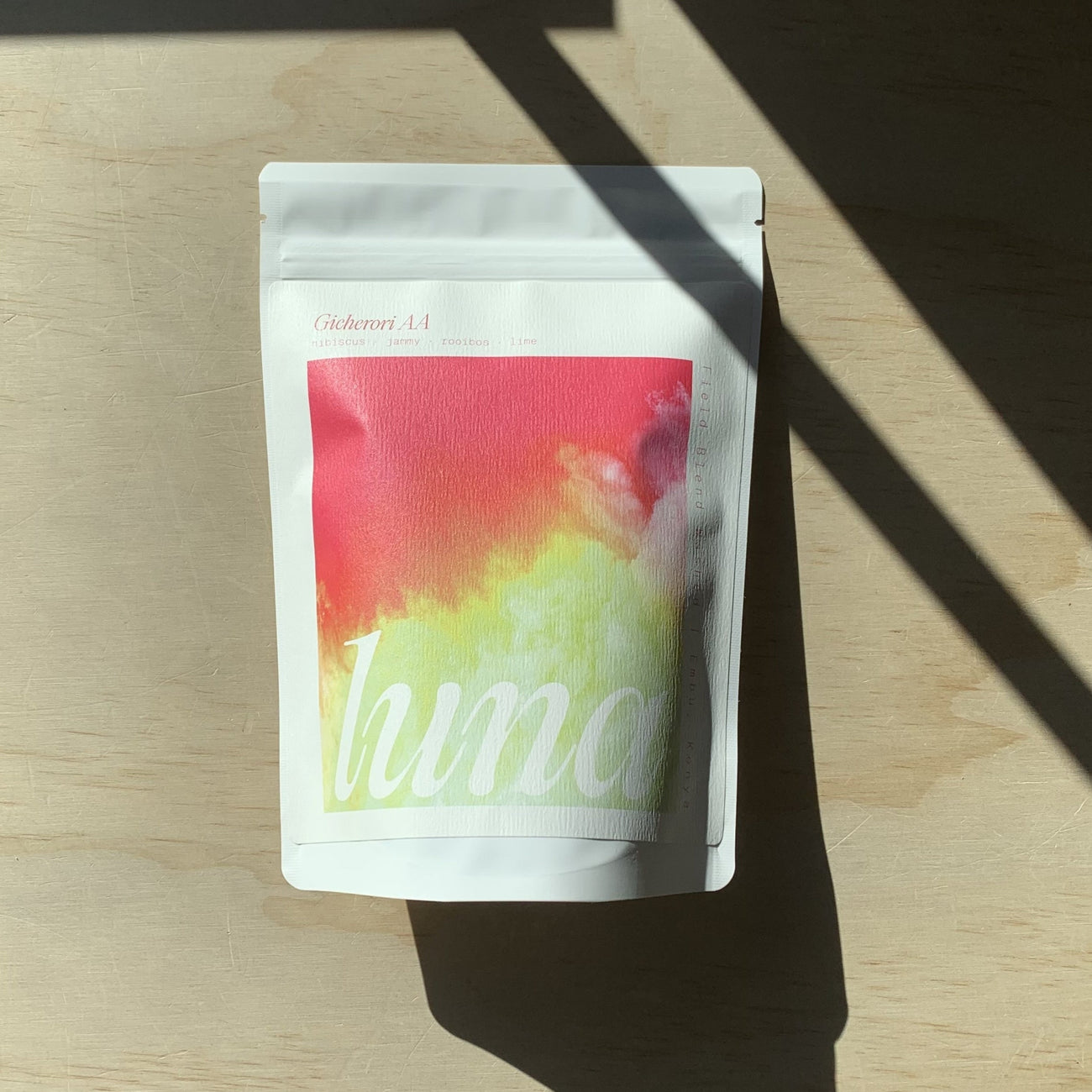
2026 Kenya • Washed
Gicherori AAField Blend
hibiscus • jammy • rooibos • lime
Embu is a coffee region that tends to not be in the spotlight as much (in favour of neighbouring Nyeri and Kirinyaga) mainly due to a much smaller production, but it's certainly not because of quality. This example from Gicherori (Kibugu Farmers Cooperative Society) has the jammy and vibrant acidity we look forward to in the most exciting coffees out of Kenya, but with the added complexity that reminds us both of things like rooibos. This lot needed to be here for our Kenya release season.
- Variety:
- Batian, SL28, SL34, & Ruiru 11
- Location:
- Embu, Kenya
- Harvest:
- Jan 2026
- Processing:
- Washed
- Cup Profile:
- jammy and sweet with hibiscus, lime, and rooibos like flavour
Gicherori AA
Gicherori factory is a relatively newly established washing station (1997 compared with others decades earlier), establishing itself as a hub for the Kibugu Farmers Cooperative Society (F.C.S.). Today, approximately 1,050 smallholder farmers channel their cherry through the facility, delivering their pickings same day. The operation doesn't stand alone: Coffee Management Services (CMS), a long established marketing agent, actively supports both the factory and its member farmers through hands-on education.
Field Blend
Batian, the new kid on the block, was first cultivated in 2010-11 is tall with pretty huge beans and is a composite variety, with SL28, SL34, Rume Sudan, N39, K7, SL4 and Timar Hybrid – This one’s known to be tasty and higher yeilding.
SL28 Selected in 1935 from a single tree in a population called Tanganyika Drought Resistant by the former Scott Labs. Recent genetic tests have confirmed that SL28 is related to Bourbon.
SL34 Selected in the late 1930s from a single tree on the Loresho Estate in Kabete, Kenya by the former Scott Labs. The tree was labeled "French Mission," suggesting Bourbon heritage, but recent genetic testing has revealed SL34 actually belongs to the Typica genetic group.
Ruiru 11 was created out of panic around a coffee berry disease epidemic in 1968 that led to the loss of half of Kenya’s production that year. The following decade was the focus of an intensive breeding program to cultivate something disease tolerant, which led to the stocky compact Ruiru 11, which is an Fl hybrid. Since this one relies on hand pollination, it’s not easy to meet the demand for seedstock.
Processing
Kenya's coffee landscape is fundamentally shaped by smallholders who deliver to central washing stations known as factories that have made washed coffees their signature. Estates have similarly built their reputations on these meticulously processed lots. While Kenyan producers employ variations of the washed process, they share a distinctive approach: a soaking step initially practiced to put coffee in a holding pattern while drying beds are freed up. This soaking step ultimately sets them apart. The process begins with selective picking and same-day depulping, followed by fermentation in open-air concrete or cement tanks for 24–48 hours. Co-operative members who work at the station then subject the coffee to rigorous washing through water channels before submerging it underwater for 12–72 hours. Finally, the beans spread across raised beds to complete their transformation through drying.
Brewing ideas
There are plenty of other great recipes out there. If you have one you already use, that's a great place to start. If you're looking for some guidance, this is our main QC V60 recipe.
V60-02 (ceramic) • 1:17 ratio (15g.:255g.) • 96C
- 0:00 - 55g. Bloom, gentle swirl just to make sure everything is saturated
- 1:00 - 155g. Center pour with dime sized circular motion until about 120g. then spiral pour out to include outer rim until 155g. finish pour around 1:20
- 1:40 - 255g. Center pour with dime sized circular motion until about 220g. then spiral pour out to include outer rim until 255g. finish pour around 2:00; gentle swirl to aid in even drawdown
finish around 2:45 depending on grinder and filters
Water:
Low ppm (Vancouver municipal water is about 30ppm); or Lotus water Light & Bright / TWW 1/2 strength give great results too.
Resting:
Best rested for 2 weeks after roast date