
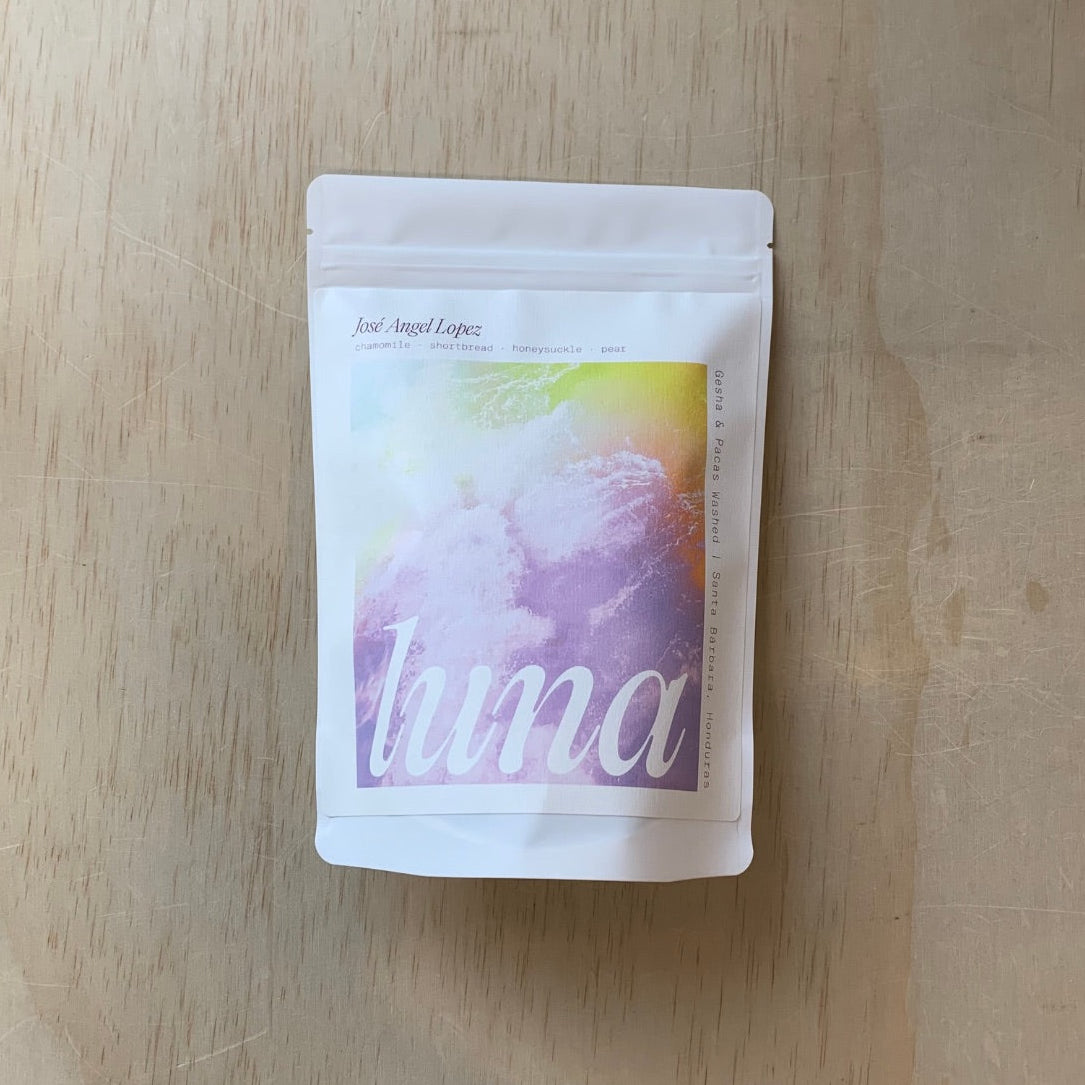
2026 Honduras • Washed
José Angel LopezGesha & Pacas
chamomile • shortbread • honeysuckle • pear
This lot was picked from José Angel's farm, Los Nopales, in Los Andes, mainly Gesha (and some Pacas) with seedstock gifted to him by the neighbouring Moreno family. Fermentation begins in sealed bags as whole fruit for the trip down the mountain, then depulped and processed as a traditional washed, in concrete tanks without water, resulting in a tea-like and elegant coffee with things like chamomile, gentle yellow fruits & honey.
- Variety:
- Gesha & Pacas
- Location:
- Santa Bárbara, Honduras
- Harvest:
- June 2026
- Processing:
- Washed (fermented in concrete tanks without water for 24hrs.)
- Cup Profile:
- tea-like, soft and delicate with honeysuckle & pear fruitiness, gentle chamomile tea, and a shortbread-type buttery finish
José Angel Lopez
José Angel Lopez is farming mainly Pacas (and a touch of Parainema & this Gesha) on a couple hectares in the Los Andes area of Santa Bárbara. That signature Santa Bárbara weather is like clockwork – cool mist enveloping the mountainsides of the national park reserve each afternoon. This micro climate is thanks to close proximity to Lake Yojoa, introducing this cooling effect that is an incredible asset to growing coffee plants slowly, allowing more time for nutrient uptake and slower maturation of the fruit.
Before working on his own farm, José was working as a picker (as well as a vegetable farmer) with the notable Moreno family in Los Andes, who gifted him the Gesha seedstock he now grows.
José didn’t have any wet milling equipment or drying tables initially, so he borrowed from neighbours to get his coffee ready for delivery to the dry mill in the first couple years. That reliance on your community to get to the next step is critical, and something we can totally relate to. Once we received that first lot five years ago, I reached out to Benjamin to see if I could buy a de-pulper for José as thanks for the lovely coffee but also thinking ahead to next year’s harvest. With one hurdle out of the way perhaps José could find a spot on his property to process his lots. Benjamin actually happened to have a de-pulper hanging around on his farm that he wasn’t using, so the next time José was at the dry mill, the de-pulper was handed over.
It's now been a couple harvest cycles & José’s systems have fully come together with the completion of a fermentation tank and a solar dryer. He still needs one more dryer to accommodate the full (growing) harvest but if this year’s coffee is any indication, he’s well on his way to an established farm producing exceptional coffees.
Processing
Los Nopales can't be accessed by truck due to the difficult terrain and clay soil, so it takes about an hour to get there on foot. Cherry is picked at this high altitude farm and brought down to his home by donkey to be processed. Cherry is carried down in sealed bags and either depulped by hand upon arrival or left overnight to depulp the following morning, Fermented in concrete tanks without water for 24 hrs. before being washed & dried on raised beds.
Brewing ideas
There are plenty of other great recipes out there. If you have one you already use, that's a great place to start. If you're looking for some guidance, this is our main QC V60 recipe.
V60-02 (ceramic) • 1:17 ratio (15g.:255g.) • 96C
- 0:00 - 55g. Bloom, gentle swirl just to make sure everything is saturated
- 1:00 - 155g. Center pour with dime sized circular motion until about 120g. then spiral pour out to include outer rim until 155g. finish pour around 1:20
- 1:40 - 255g. Center pour with dime sized circular motion until about 220g. then spiral pour out to include outer rim until 255g. finish pour around 2:00; gentle swirl to aid in even drawdown
finish around 3:00 depending on grinder and filters
We're using Abaca filters and grinding around 575um @900rpm on our Z2 80mm ULF burrs
Water:
Low ppm (Vancouver municipal water is about 23ppm, Maple Ridge is about 32ppm); or Lotus water Ultra Light (about 45ppm)/ TWW 1/2 strength give great results too.
Resting:
Best rested for 2 weeks after roast date